Friday, 9 October 2020

Alison Steel, the Night Bird at WNEW-FM

Alison Steele (born Ceil Loman in Brooklyn, NY on *26 January 1937 +27 September 1995) was an American radio personality, writer, television producer, correspondent, and entrepreneur who was also known by her air name, The Nightbird. She was inducted into the Rock and Roll Hall of Fame.

Alison Steele, the Night Bird of WNEW-FM, is the most successful female disc-jockey in the country according to Sunday News17 February 1974.

Current ratings show that, in any given quarter-hour of her show more than 100,000 people are tuned in to the station. Why do so many people stayed tuned into her ‘nightly excursions’ (Monday through Saturday10 p.m. to 2 a.m.) ? One listener said: ‘She has some sort of irresistible quality about her. You can easily fancy her to be something larger than life.’

How did she get where she is? ‘You just don’t become great overnight. You’ve to work at it. If what you want  is tough to get, you have to fight for it. It has taken me 7 years of hard work to get where I am right now. However, I don’t think I’ll ever be satisfied. Each night I try for a higher plateau and I think my audience responds to my trying.’

Her deepresonant voice is distinctive. She has been called a temptress, and a writer has asserted that she could make a commercial for gym socks sound sensuous.

Finding the bright side

‘I have an optmistic philosophy,’  Alison said. ‘I’ve always gone by the idea that there’s something fine in life, but you have to make the effort to find out what it is.

‘I’m tired of people bitching and moaning that they can’t get a break. I abhor negativism. I’m positive about everything I do. We’re so used to the negativism that has crept into our daily lives, all we can do is put down others who are honestly trying.’

Where did Alison Steele get the nerve to challenge this tough, competitive industry?

‘It was my mother’s influence actually ,’ Alison said with a smile. ‘She taught me a very simple rule: if I wanted something, all I had to do was go and get it. She helped me get self confident when I was 14. There was an ad in our local paper  for a tall good-looking girl to fill a part-time slot. I was neither tall nor pretty, but my mother told me to go and get it anyway. I went down, bluffed my way in, then worked hard until I got it right. I was off to a great start.’

Now, aside from her radio excursions as ‘The Night Bird’, Alison does one other rock radio show, syndicated to 600 stations, a radio show for women, and a TV talk show broadcast over the Sterling Cable TV network that is seen by 55,000 viewers in the New York area.

Happy where she is

Can success spoil Alison Steele? ‘Not really,’ she replied. ‘I have a lovely job, which is most gratifying, and I love making a lot of money.’ Alison declined to say just how much money she makes. 

Alison does quite a bit of work for local charities. She’s a member of the board of the New York City Chapter of the Epilepsy Foundation, gives a lot of time to the Muscular Dystrophy Foundation and is on the credit committee of the American Federation of Television and Radio Artists.

Her days are busy. She has to listen to the new albums, takes care of personal errands, auditions for commercials and still finds time to answer each fan letter.

‘I’ve hundreds of letters at home I still have to answer. My biggest regret is that I’m 6 to 8 months behind in my replies. But I’ll catch up, I promise.’

‘People call me because they’re lost or upset,’ Alison said. ‘I try and point them in the right direction of self-help and love for oneself. I stress the idea that if you’re positive about things, you’ll enjoy what you have all the more. People call me when they have nowhere else to turn and I’m glad I can help. When I do hear from someone who’s troubled I’m patient and understanding. I listen, ask no names and just give my particular brand of advice. I usually hear from those I’ve spoken to a while and they thank me. God, that makes me feel good! It’s fine to know you’ve helped somebody, somewhere, sometime.’

SUNDAY NEWS 17 February 1974
By K. Michael Blumberg

Clockwise from lower left: Ann Clements, Alison Steele, Harvey Glascock, vice president and general manager of WNEW-FM,  Arlene Kieta, and Margaret Draper.
New York Times, 9 December 1971

Alison Steele, disk Jockey, dies; the pioneer 'Nightbird' was 58

By David Stout for The New York Times
augmented by Wikipedia information

28 September 1995

Alison Steele, whose sultry voice and iron will helped her become one of the first women in the country to be hired as a disk jockey, died yesterday, 27 September 1995, at Lenox Hill Hospital in Manhattan. She was 58.

Ms. Steele, who lived in Manhattan, died of cancer, her family said.

She was widely known to late-night radio listeners as "the Nightbird." Her most recent perch was WXRK, a classic rock-and-roll station at 92.3 FM. She was on Monday through Friday from 2 to 6 A.M.

Ms. Steele loved to work hours that most other people find good for sleeping. "I'm a night person," she said in 1971, when she was with WNEW, where she worked on AM and FM for about 14 years. "I think it has a mysterious quality. I never get lonely up here."

She usually received 25 to 30 telephone calls a night; in her early years, she also had her champagne-colored French poodle, Genya, to keep her company, chewing on a bone in the studio as Ms. Steele talked to listeners.
Alison Steele with Jack Beeb.

Ms. Steele also worked for WPIX radio and often did voice-overs for radio and television commercials, according to her sisterJoyce Loman. Her syrupy voice was not affected by a flirtation with miniature cigars that she indulged in her early days on radio but gave up years ago, her sister said.

Ms. Steele and her sister operated Just Cats, a feline boutique on East 60th Street in Manhattan, but Ms. Steele was fond of dogs as well.

She is a member of the Rock-and-Roll Hall of Fame in Cleveland and in 1976 became the first woman to receive Billboard Magazine's "FM Personality of the Year" award.

Ms. Steele was born Ceil Loman on 26 January 1937, in Brooklyn, New York. In one interview, she had wished for a career in show business at three years of age. At 14, she landed a job running errands for a NYC television station, and opted not to study at university as she was "too impatient".

In the 1950s, Steele had worked on her career to become a production assistant and associate producer for various New York City television and radio stations. Among them was Ted Steele's television show, The Ted Steele Show, on WOR-TV, where she hosted interviews and performed fitness routines that encouraged viewers to take part in. Ted was still married to his second wife Doris at the time.

She married orchestra leader and radio and television host Ted Steele who was 20 years her senior. The marriage ended in divorce. The couple had a daughter, Heather.

1966–1979: WNEW

On 4 July 1966, Steele landed her first radio job when she became a part of the new line-up of disc jockeys for the newly launched rock stationWNEW. The station wished to only hire female air staff at first as part of its middle-of-the-road format it marketed "sexpot radio", with Steele chosen as one of the final four selected out of the 800 women that applied. Steele worked the 2:00 - 7:00 p.m. slot, Sunday through Friday.

When WNEW abandoned the format after the 18-month-trial to the increasingly popular progressive rock format, Steele was the only host that was asked to stay at the station.

"I've never called in sick; I've worked hard and built my own following," she once said, to explain her popularity.

On 1st January1968WNEW placed Steele in the overnight "graveyard shift" which granted her more creative freedom, leading her to develop her on-air personality and rapport with her listeners. "I thought there must be a lot of people ... that need something to relate to in the middle of the night, and if I could create some kind of camaraderie, a relationship between myself and the rest of the night people, then it would be more than just music". She thought of a new air name, based on the gender ("bird" being slang for a girl while 'teddy' was slang for a boy, following the 1964 British invasion) and her night owl hours of work, and chose The Nightbird.

Steele would begin her night show by reciting poetry over music, before introducing her show in her distinctive soft and sultry voice, aided by her preference of smoking small cigars. She often hosted with her dog, a French poodle named Genya. Her regular introduction was: "Hello night bird. How was your day? Did you visit the gods in the valleys far away? What did you bring me, in your visit from the sea?"

The flutter of wings, the shadow across the moon, the sounds of the night, as the Nightbird spreads her wings and soars, above the earth, into another level of comprehension, where we exist only to feel. Come, fly with me, Alison Steele, the Nightbird, at WNEW-FM, until dawn.

She then transitioned to recordings of some of the more exceptional and experimental music being recorded at the time, as well as featuring the best of the familiar favorites of her audience. As well as music, she recited texts and poetry over music.

Almost every morning, to fill in the minute before the end of her show and the start of the next, Alison Steele would play the Beatles’ “Flying”: a two-minute instrumental from the Magical Mystery Tour soundtrack, a deadpan Mellotronism, a piece of marshmallow. Steele would deliver the morning’s final benedictions and vocal nuzzlings over the music, kiss you goodbye before leaving you to your day. And the first time I heard her play her show out with it, a faint but decisive thonk!! sounded in my skull. The sound came from a small paragraph I’d never forgotten, hidden in the center of a book I’ve mentioned before on this blog - 'The Beatles Forever' by Nicholas Schaffner.

By 1971, Steele had acquired approximately 78,000 nightly listeners, the majority being men between 18 and 34.

She was a supporter and promoter of the English rock bands YesGenesis, and the Moody Blues. By 1974, she had more than 100,000 listeners at any given average quarter hour of her show, and hosted a syndicated rock radio show to 600 stations nationwide, a radio show for women, and a cable television talk show.

According to Jimi Hendrix's manager Michael Jeffery, the song "Night Bird Flying", recorded by Hendrix and released posthumously on the album The Cry of Love (1971), was inspired by Steele's show. Steele became known as "The Grande Dame of New York Night".

At one point, she served as the station's music director. In 1976, Steele became the first woman to receive a Billboard Award for FM Personality of the Year, and the magazine also named an award in her honour, The Alison Steele Award for Lifetime Achievement, which was first awarded to Casey Kasem in 1997.
1979–1984: Television and writing work

After her departure from WNEW, Steele focused her career around television and writing. From 1982-1984, she was the announcer for the daytime soap opera 'Search for Tomorrow', and was the producer, writer, and correspondent for Limelight on CNN.

1984–1995Return to WNEW and WXRK

In 1984, Steele returned to radio on WNEW–AM which lasted until 1986. For a number of years, Steele was also the disc jockey for the pop/rock in-flight audio entertainment channel on board Trans World Airlines.

Steele's final radio job was working overnights at WXRK from 1989-1995. She also did some work for VH1, as well as running the cat boutique Just Cats with her sister Joyce in Manhattan.

Steele did much voice-over work for radio and television commercials, and she provided the narration for one of Howard Stern's popular radio bits, "Larry Fine at Woodstock", featuring impressionist Billy West.

Steele also did charity work and was a member of the board of the New York City chapter of the Epilepsy Foundation, worked for the Muscular Dystrophy Foundation, and was on the credit committee of the American Federation of Television and Radio Artists.

In June 1995, Steele was forced to leave WXRK due to illness from stomach cancer. She died on 27 September 1995, at Lenox Hill Hospital in Manhattan, aged 58.

In addition to her sister Joyce, of Manhattan, she is survived by a daughter, Heather Steele, of South Dakota; another sister, Emalie Daniel, of Houston, and a granddaughter.

Steele at NYC Public Access TV show 'Beyond Vaudeville' on 15 September 1992.
Alison less than 2 years before her death. 
Steele & 'Beyond Vaudeville' host Frank Hope on 15 September 1992.
Alison Steele & William Brown at 'Beyond Vaudeville' that was aired by NYC Public Access TV up to the time MTV scooped it up as 'Oddville, MTV'.

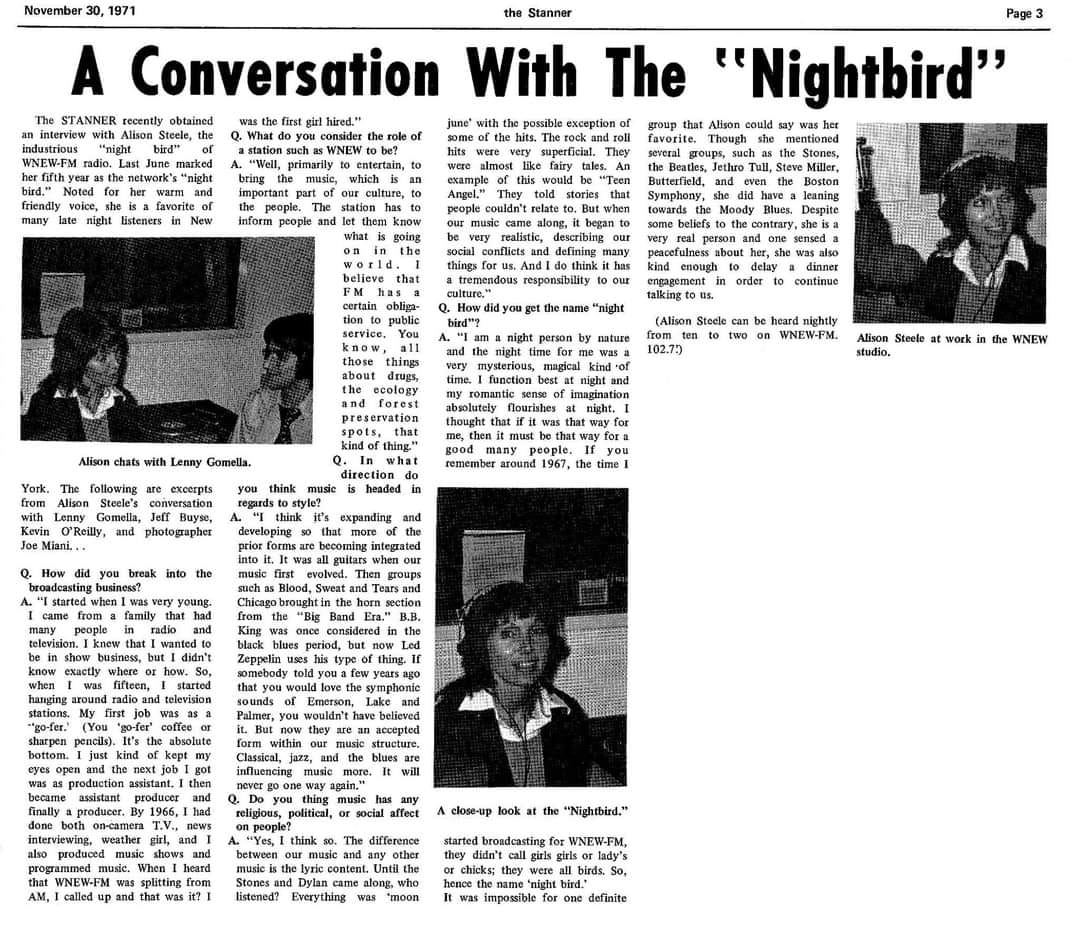
My 1977 high school newspaper interview with Alison Steele. I was editor-in-chief of Archbishop Molloy's (Queens, NY) newspaper The Stanner when Alison granted me a meeting at the WNEW-FM studios. Very nice, kind and classy lady.
Mark Bradford Barbour posted this article at Facebook's "Alison Steels: the Nightbird" page on 17 August 2020: My 1977 high school newspaper interview with Alison Steele. I was editor-in-chief of Archbishop Molloy's (Queens, NY) newspaper 'The Stanner' when Alison granted me a meeting at the WNEW-FM studios. Very nice, kind and classy lady.

Mark: What do you think about the punk rock scene in England?
Alison: Well, I realize that there has to have their own property as far as music is concerned. And musically, there are some good punk rock groups. The only ones I'm not too thrilled about are the ones that brag about the fact that they only know two chords. I think it's kind of an insult to the music industry and to the people who studied and really tried. If the record companies can reject the punk rock that's bad musically, then that's great because it's exciting. It's a new form which we need. Music has been very dull in the last couple of years. 

Mark: What are your own musical preferences
Alison: It depends on my mood. I like all music. I love rock, and I like folk music and middle-of-the-road music. I also like classical music. If there isn't a good old movie on when I go home, I might listen to some classical music.

Mark: What about classical rock?
Alison: I suppose I have a soft spot for classical rock, for ELP (Emerson, Lake & Palmer), for Yes, the Strawbs, ELO (Electric Light Orchestra) and Pink Floyd. It's very hard to say what my own preference would be. As I say, it depends on my mood. 

Mark: What sort of things you enjoy besides music?
Alison: I like sports, I enjoy hockey, football and all participation sports. I like to swim. I like all forms of exercises. I'm a movie freak. I also like to cook. 

What kinds of food do you like to cook?
Alison: Everything, especially spicy food. I'm a really good cook. I like to cook for people, and I like to entertain. 

Mark: Do you always enjoy working, or are ever days when you don't feel like coming in?
Alison: Yeah, I get a lot of days when I don't feel like coming in, but the minute I get in, I'm fine. It's like going into cold water. 

Mark: Where do you get the poems that you use?
Alison: From a variety of places, anything from greeting cards to the Bible. 

Mark: Do you ever write your own?
Alison: Oh yeah, sure. And then a lot of times listeners send them in. I have just always been a poetry buff. Then I started collecting books. I've got hundreds of books and I look through them. Sometimes I'll get a card and there'll be a pretty rhyme on it. It can just be from anything. I don't draw the line any place. 

Mark: Can you tell us about some of the things WNEW will be doing in the future?
Alison: Well, you know about the Emerson, Lake & Palmer concert. The Christmas concert is coming up too. They're deciding now who's going to be playing. 

Mark: Did you always want to be a deejay?
Alison: No, I never thought about being a deejay, as a matter of fact. I started out in television and hadn't the slightes thought about being one. So when WNEW was looking for girl deejays, it was the only thing I hadn't actually done yet. The only thing I had to do was to cue the record, and I figured it couldn't be very hard. It wasn't.
1971.

hear Ms Steele's voice at:
https://www.youtube.com/watch?v=6LUqqueEy-4&feature=share&fbclid=IwAR1gYIhACDszXKNq69Vd_KLDvgx-Yig6_F6Duo2VtCPNqDxxDcYMJ8RcJ_o
Alyson Steel's interview. 


Pete Fornatale, DJ at WNEW-FM

 Peter "Pete" Fornatale, a New York City disc jockey and author of numerous books on rock'n'roll music is considered a "pioneer of FM rock" and was the first person to host a rock music show on New York City's FM band, commencing on 21st November 1964, on WFUV.


By broadcasting progressive rock and long album tracks, he was noted for introducing a musical alternative to Top 40 AM radio in New York in the late 1960s and early 1970s. Billboard called his station "a legend, affecting and inspiring people throughout the industry."

DJ Pete Fornatale with a voice of gold...

Peter ("Pete") Fornatale was born on 23rd August 1945, in the Bronx, New York. Pete died on 26 April 2012, in New York City. He had suffered a brain hemorrhage on 15 April 2012, and had been in ICU.

He was the first DJ to host a rock music show on New York City's FM band, starting on 21st November 1964 on WFUV. By broadcasting progressive rock and long album tracks, he was noted for introducing a musical alternative to Top 40 AM radio in New York in the late 1960s and early 1970s. 

He gave early exposure to country-rock bands like Buffalo Springfield and Poco, and did one of the first American interviews with Elton John.

Starting with WOR-FM in 1966, FM was demonstrating a large rift from AM broadcasting. 

Fornatale was a key figure in this trend with his weekly program, "Campus Caravan," which was heard on Fordham University's WFUV from 1964 to 1970

He began professionally in 1969 at WNEW-FM and also worked at WXRK.

He was a native of the Belmont section of the Bronx and attended Fordham Preparatory School and Fordham University, where he received a B.A. in Communication Arts in 1967. 

Pete Fornatale, James Taylor & JOP.

Pete Fornatale, a Pioneer of FM Rock, dies at 66

by Douglas Martin
27 April 2012

Pete Fornatale, a disc jockey who helped usher in a musical alternative to Top 40 AM radio in New York in the late 1960s and early 1970s, presenting progressive rock and long album tracks that AM stations wouldn’t touch and helping to give WNEW a major presence on the still-young FM dial, died on Thursday, 27 April 2012 in Manhattan. He was 66. The cause was complications of a stroke, his son Mark said.

FM radio had been around for a while but did not come of age until the 1960s, when, amid the whirlwind of a growing counterculture, the federal government mandated that FM stations carry different programming from that of their sister AM bands. Enterprising D.J.’s grasped the chance to play longer, fresher, rarer music and give voice to the roiling political and social issues of the day.

Mr. Fornatale was at the forefront of the FM revolution, along with WNEW-FM colleagues like Scott Muni, Rosko, Vin Scelsa, Dennis Elsas, Jonathan Schwartz and Alison Steele (who called herself “the Nightbird”). They played long versions of songs, and sometimes entire albums, and talked to their audiences in a conversational tone very different from the hard-sell approach of their AM counterparts.

WNEW-FM may have been the most influential experimenter. When the station dropped rock music for talk radio in 1999, Billboard called it “a legend, affecting and inspiring people throughout the industry.”

Mr. Fornatale (pronounced forn-a-TELL) had actually beaten WNEW to the punch. As a sophomore at Fordham University in 1964, he persuaded the school’s Jesuit leaders to let him do a free-form rock show on what was officially an educational station. He continued that show for a few years after he graduated, and for a while could be heard on both WFUV and WNEW.

WOR-FM became the first commercial station in New York to adopt the format, in 1966, but abandoned it after about a year. WNEW, with the slogan “Where Rock Lives,” adopted it in 1967.

Mr. Fornatale came on board in 1969 and quickly moved to the center of New York’s music scene. He gave early exposure to country-rock bands like Buffalo Springfield and Poco. He did one of the first American interviews with Elton John, and got a rousing ovation when he brought a rented surfboard to Carnegie Hall for a Beach Boys show. He introduced Curtis Mayfield to Bob Dylan at a Muhammad Ali fight.

In 1982 he started “Mixed Bag,” a program that emphasized singer-songwriters, on Sunday mornings. His regular guests included Suzanne Vega, who introduced herself to him by sending a fan letter.

One of Mr. Fornatale’s signatures was playing songs that followed a theme. It might be colours, with a playlist including the Beatles’ “Yellow Submarine” and Joni Mitchell’s “Blue.” Or it might be great inventions, as when he celebrated the 214th anniversary of the United States Patent Office. Or the theme might simply be radio.

Peter Fornatale was born in the Bronx on 23 August 1945, and graduated from Fordham Preparatory School, on the campus of Fordham University. His introduction to rock ’n’ roll came in 1956 when his father summoned him to the television to see “this crazy guy” — Elvis Presley. The first record he bought was Presley’s “Hound Dog.”

Mr. Fornatale graduated from Fordham with a degree in communications in 1967 and taught English at a Roman Catholic high school before joining WNEW. His voice drew praise for its mellow, almost professorial tone, although some listeners may have chosen to describe it as nasal.

By the early 1980s, stations specializing in what had been known as free-form radio were bringing in business consultants who urged less variety in records and more control over the disc jockeys. Mr. Fornatale later complained that he and his colleagues had been demoted from chefs into waiters, “and fast-food waiters at that,” as he told The Record of Bergen County, N.J., in 1999.

He left WNEW in 1989 to follow the station’s program director to WXRK-FM (K-Rock), which followed a more conventional approach to pop music. Mr. Fornatale’s show came on after Howard Stern’s. Mr. Stern, whose shock-jock format was becoming radio’s new wave, called Mr. Fornatale the “anti-Stern.”

In 1997 Mr. Fornatale returned to WNEW-FM, which had decided to go back to album-oriented rock after a succession of owners and formats. But within a year the station had changed formats again, to talk. In 2001, Mr. Fornatale returned to where he had started: WFUV. “I love the idea I’ve come full circle,” he said.

Mr. Fornatale wrote several books, including one on the making of Simon and Garfunkel’s 1968 album “Bookends,” and one on the Woodstock music festival. He was also the main writer for a series of 600 trading cards on the life of Elvis Presley.

He had lived for six years in Rockaway, Queens, and the previous four decades in Port Jefferson, N.Y.

Mr. Fornatale’s marriage to Susan Kay Flynn ended in divorce several years ago. He is survived by his sons, Peter, Mark and Steven, and his brother, Robert.

His WFUV show, which like his earlier WNEW singer-songwriter show was called “Mixed Bag,” ran from 4 to 8 p.m. on Saturdays.

“If you give me the right idea for a program,” Mr. Fornatale said in 2004, “I can give back to you a three-hour journey where, if you tune in at any time, you’re likely to hear something that will entertain you. But if you take the ride with me, when we get to the end, you’ll say, ‘Wow, what a long, strange trip it’s been.’ ”

A version of this article appeared in print on April 27, 2012, on page A19 of the New York edition with the headline: Pete Fornatale, a Pioneer Of FM Rock, Dies at 66.

Vin Scelsa or Vincent Anthony Scelsa was born 12 December 1947, in Bayonne, New Jersey and was at "the forefront of the FM revolution".

Casey Kasem in 'American Top 40'


Casey Kasem in Hollywood.


I went to live in the USA in 1971. I made Newark, N.J. my American town and I used to listen to New York City's radio stations. WABC was Brazilians' favourite radio stations but I listened to all of them and preferred FM stations because the sound was clearer. I don't know exactly when but I found out about Casey Kasem's program 'American Top Forties' on a Sunday morning in the 1972 Fall when I was searching the dials for my favourite songs. 

WPIX FM 102 was the radio station in which I listened to 'American Top 40'. I had been a fan of Hit Parades on the radio since I was a kid of 11, when my family moved from a small town to São Paulo. I was extremely happy to find a Hit Parade show on WPIX on the Sunday morning exactly as I was used to do it in the early 1960s in Brazil. 

I used to tape parts of the show to be able to listen to Casey later. My English was not very good and I had to listen to the same thing sometimes up to 10 times to understand what had been said. I could easily say that Casey Kasem was one of my best teachers of English-as-a-foreign language. I still have a cassette tape where Casey Kasem announces the Number One single of the week: 'Baby don't get hooked on me' by Mac DaviesMichael Jackson's 'Ben' was the runner-up. 

When I came back to Brazil, I kept listening to the tapes I had recorded in 1972-1973 so I could keep English in my consciousness. I kept on increasing my understanding of the language through listening to the same tapes over and over. In Brazil there is a law enacted during WWII that bans foreign-language radio programs, so 'American Top 40' was never beamed in our shores.

Next time I listened to Casey Kasem's 'American Top 40' was in mid-1975 when I returned to the USA. Captain & Tenille's 'Love will keep us together' was #1

When I went to live in Sydney, Australia, in 1981, I was surprised to find 'American Top Forties' on 2UE on the Sunday morning too. I was in heaven again, even though I thought the 1980s were not so glamorous as the 1970s. But still, it was so good to be able to listen to Casey and the information he provided about new and old acts in the countdown. Olivia Newton-John was #1 with 'Physical', that went to be the song with most weeks a #1 for the longest time.

I don't remember when I stopped listening to 'American Top 40'. Probably by the late 1980s when I sort of lost my interest for pop music in general.

I'm really sad to know that Casey Kasem passed away on 15 June 2014. I've read a few articles about his death, but I'm more interested in his life than his death. Everyone will die one day, anyway. So here's some facts about the life of such a wonderful guy:


Casey Kasem's 'American Top 40', which first aired in the summer of 1970, was a weekly 4-hour feast of homey sentiment and American optimism that ran headlong into the prevailing spirit of rebellion in the music culture of the day.

At the height of his career, Casey Kasem was among the best-known D.J.'s in the country. His weekly 4-hour show defined middle-of-the-road radio taste in America at the time. The show gave new life to the Top 40 format at a time when the popularity of the 45 rpm record was waning and FM disc-jockeys were experimenting with more personal formats, creating playlists from their favourite long-playing album cuts.

Mr. Kasem, instead, featured only the singles that Billboard magazine had ranked as the country's most popular in the past week, based on its analysis of airplay - a playlist, in effect, based on the national pop consensus.

Building a radio show on the notion that such a consensus existed was considered a risky proposition in the culturally splintered time. As Time magazine put it, 'He embraced corniness as Vietnam-era cynicism peaked.' But the format struck a chord.

Only 5 radio stations carried the debut of 'American Top 40' on 4 July 1970. But within a year more than 100 did, and by the mid-1970s it had reached nearly 1,000 outlets 'coast to coast', as Mr. Kasem liked to say, making him one of the best-known DJs in the country.

He had modeled the show, he later told interviewers, on the old NCB radio program 'Your Hit Parade' (also known as 'The Lucky Strike Hit Parade'). 'I thought we'd be around for at least 20 years,' he said. 'Because I knew the formula worked'.

'American Top 40' became a mainstay of American radio, offering a crowd-pleasing menu of hits seasoned with Mr. Kasem's heartfelt readings of listeners' song dedications, wholesome anecdotes about the lives of the pop stars, and an endless store of solid, if cringe-inducing, pieces of advice, like his touchstone signoff: 'Keep your feet on the ground and keep reaching for the stars'.

Not all the dedications were necessarily feel-good, however. A pregnant teenager addressed her boyfriend in prison, for example, and a mother begged her runaway daughter to come home.

Mr. Kasem also hosted a syndicated TV version of the show in the 1980s. But his relationship with 'American Top 40' ended in 1988 because of a contract dispute with his syndication company. The next year, 1989, he started 'Casey's Top 40', a competing radio program on another network, bringing most of his old audience there with him.

About 10 years later, 1999, after acquiring the rights to the name, he was again hosting a show with the title 'American Top 40' (for a time he hosted both that and the competing 'Casey's Top 40'). He ended his three-decade run in 2004, handing the hosting duties to Ryan Seacrest, who continues in that role. Mr. Kasem retired in 2009.

Mr. Kasem, who had a financial interest in his shows, had a net worth estimated by several sources at $80 million. Last year he put his house in the Holmby Hills area of Los Angeles on the market for $42 million.

Rock'n'roll was never Mr. Kasem's passion, he told interviewers. He knew his subject, and kept up with it in a professional way, but when home, he told Billboard, 'I find myself just wanting to sit in my office and make it as quiet as possible'.

'If I were doing a real rock show,' he told The New York Times in 1990, 'then it would matter to know how I felt about what I was playing'. But, he added, 'I'm just counting them down as they appear on the chart, 1 through 40. What really matters is what I say between the songs'.

Between the songs Mr. Kasem managed to herald the newest of the new with a broadcast style that felt comfortingly old. He set the tone with a neighbourly but precise 1940s-style diction, honed to amiable perfection in a second career as a voice-over artist. With plain-spoken warmth and a partiality to sentiments and phrases ('coast-to-coast' and 'sweetheart' were his favourites, hands down), his delivery evoked another time. 

'Hello again, everybody', he said to open most of his shows. 'I'm Casey Kasem, and welcome to 'American Top 40'. I'm all set to count down the 40 most popular songs in the U.S.A.'

When he used biographical teasers to introduce songs ('a high school dropout and a runaway, with a mother who was married six times - coming up,' referring to Cher), Mr. Kasem echoed Paul Harvey on his folksy, long running news broadcasts. But he told NYT that the technique harked back to his childhood in the Middle Eastern immigrant neighbourhood of Detroit.

'I was drawing on the Arabic tradition of storytelling one-upmanship,' he said. 'When I was a kid, men would gather in my parents' living room and tell tales and try to outdo each other. I couldn't understand the language, but I was fascinated.'

Kemal Amen Kasem was born in Detroit on 27 April 1932. His parents Amin and Helen Kasem, were Lebanese immigrants who owned a grocery store.

After graduating from Wayne State University in Detroit, he worked in local radio, produced broadcasts for the Armed Forces Network during a stint in the Army and landed in Los Angeles, at KRLA, where he developed his trademark of introducing records with historical tidbits about the artists and their songs. For a time he also had a local television dance show.

In 1970, along with Don Bustany, a Hollywood movie producer and childhood friend, Mr. Kasem came up with the idea of a countdown radio show modeled after 'Your Hit Parade' and proposed it to the syndication company Watermark Inc., which was later bought by ABC Radio Networks. Mr. Kasem had always wanted to be a movie star, he told interviewers, but never had much success beyond cameo roles in films like 'New York, New York' (1977), in which he played a 1940s disc jockey, and 'Ghostbusters' (1984), in which he played himself.

Casey Kasem's biggest role off the radio was in the TV cartoon series 'Scooby-Doo, Where Are you!' as the voice of Shaggy, the canine hero's goofy companion. In the 1970s and 80s his voice was heard on TV commercials for Sears, Ford, Chevron, Oscar Mayer and Heinz.

Following the Israeli invasion of Lebanon in 1982, Mr. Kasem, whose parents belonged to the Druze sect in Lebanon, an offshoot of Islam, became a vocal advocate for Middle East peace and Arab-American causes. In later years he was active in promoting Arab-Israeli dialogue, making personal appearances at mosques and synagogues around the country.

Mr. Kasem, with an audience of 10 million listeners in his heyday, made politeness and decorum hallmarks of his broadcast. His courtly voice seemed capable of rendering the most raunchy song titles in appropriate-sounding phonemes, and when not able, to swerve around the problem effortlessly.

He would no say 'I want your sex' when that was the title of a 1987 hit song, for instance. Instead, Mr. Kasem introduced that one as 'George Michael's latest'.

Given the audicence he imagined for himself, Mr. Kasem could hardly do otherwise. 'I picture people in a car, with Mom and Dad in the front seat, a couple of kids in the back seat, and a grandparent as well,' he told Billboard.

In another interview, he said: 'I feel good that you can be going to synagogue, mosque or church and listen to me, and nobody is going to be embarrased by the language that I use, the innuendo. Quite frankly, I think we're good for America'.


Casey Kassem compering TV show 'Shebang' in the 1960s. 

Casey Kasem, wholesome voice o pop radio, dies at 82.

by Paul Vitello for The New York Times
15 June 2014.

Casey Kasem, a disc jockey who never claimed to love rock'n'roll but who built a long and lucrative career from it, creating and hosting one of radio's most popular syndicated pop music shows, 'American Top 40', died on Sunday, 15 June 2014, in a hospital in Gig Harbor, Washington. He was 82.

His death was announced by Danny Deraney, a spokesman for Mr. Kasem's daughter Kerri. Mr. Kasem had Lewdy body dementia, a progressive disease of the body's neurological and muscel cells.

In addition to his wife, who played the tall, blong, dimwitted character Loretta Tortelli on the sitcom 'Cheers', and their daughter, Liberty, his survivors include his 3 children from a previous marriage, which ended in divorce: Julie, Michael and Kerri Kasem.

In 2007, after he learned he had Lewdy body dementia, Mr. Kasem gave his 3 oldest children legal authority to act as his health care proxy at whatever point he became unable to make decisions himself. The agreement stipulated that he did not want to be kept alive with 'any form of life-sustaining procedures, including nutrition and hydration', if he lost all cognitive function and was given no hope of recovery. Differences between the 3 older children and Mr. Kasem's wife played out in increasingly bitter courtroom clashes in the final months.

In his final months, Mr. Kasem, who had lived in Beverly Hills, California, was at the centre of a family legal battle over the terms of his death, pitting his wife, the actress Jean Kasem, against his 3 adult children from a previous marriage. Ms. Kasem removed her husband from a Santa Monica nursing home on 7 May 2014 and took him to stay with friends in Washington State. By courd order, he was moved to the hospital on 1 June.

Olden immigrant photos


Italian family arrive in Ellis Island, N.Y.

another Italian family arriving in New York...
power-house mechanic in 1921.
Up up and away... 
Black Union soldier guarding a slave auction house in Atlanta, Georgia in 1864.

Thursday, 1 October 2020

Mac Davis - 1942-2020

Mac Davis, pop and country singing star, is dead at 78

After writing hits for Elvis Presley and others, he became famous in his own right when “Baby don’t get hooked on me” went to #1 on 5 August 1972, and stayed at the top for 3 weeks. 

Nashville - Mac Davis, the pop-country crossover star who wrote hits for Elvis Presley and had a No. 1 pop single of his own with “Baby Don’t Get Hooked on Me,” died on Tuesday , 29 September 2020, at a hospital here. He was 78. His manager and friend, Jim Morey, said the cause was complications of Mr. Davis’s recent heart surgery.

Morris Mac Davis was born on 21st January 1942, in Lubbock, Texas the second of three children. He and his sister, Linda, spent their childhood living in an efficiency apartment complex with their father, T.J., a building contractor, after their parents divorced; his brother, Kim, grew up in Atlanta their mother, Edith.

Mr. Davis’s first guitar was a gift from his father when he was 9 years old. But he was less interested in music than in sports and fist-fighting until he finished high school and moved in with his mother in Atlanta, where he started a rock ’n’ roll group called the Zots.

The band released a pair of singles on a local label before Mr. Davis accepted a job as regional manager for Vee-Jay Records, the influential independent label that was home to popular R&B singers like Jerry Butler and Gene Chandler.

He moved to Liberty Records in the mid-1960s and was soon transferred to Hollywood, where he worked for the label’s publishing division before leaving to join Boots Enterprises, the production and publication company owned by Nancy Sinatra.

While working for Ms. Sinatra, he played on her studio recordings and in her stage shows. He also began publishing his own songs and persuading Presley and other artists to record them.

He left Boots Enterprises in 1970, shortly after meeting the Columbia Records executive Clive Davis and signing a recording contract with the label. 

Mr. Davis enjoyed early success as a songwriter in 1969, supplying Elvis Presley with hits like “In the Ghetto#3 on 17 May 1969, and “Don’t cry daddy” #6 on 13 December 1969 after spending much of the 1960s working in sales and publishing for independent record companies.

He also wrote “Something’s burning,”  #11 on 14 March 1970, for Kenny Rogers & the First Edition, and “I believe in music,” #22 on 7 October 1972, for Detroit pop group Gallery.

I believe in music” was recorded by scores of artists and became Mr. Davis’s signature song; he closed his concerts with it for decades. “Watching Scotty Grow,” #11 on 9 January 1971, recorded by Bobby Goldsboro is another of his best-known compositions. 

Singing in a warm, resonant baritone, Mr. Davis recorded many of these originals himself, working in a Southern pop vein akin to that of Presley, whom he often cited, and his fellow Lubbock, Texas, native Buddy Holly, whom he called his greatest musical influence.

“He was like nothing I’d ever seen before,” Mr. Davis said in an interview with the website Elvis Australia about the first time he saw Presley perform onstage, in a parking lot at the county fairgrounds in Lubbock.

“Of course, I was just a kid (14), you know,” Mr. Davis went on. “So was he (21).”

Genial, photogenic and fit, Mr. Davis had his own television variety hour, “The Mac Davis Show,” from 1974 to 1976 on NBC and was a regular guest on “The Tonight Show” and other talk shows in those years. 

Then all hell broke loose when “Baby don’t get hooked on me” went to Number One on 5 August 1972, and stayed on top for 3 weeks. 'One hell of a woman', his follow up single got to #11 on 25 May 1974.  

Buoyed by singalong choruses and a handclap beat, “Stop and smell the roses,” #9 on 7 September 1974, was his 2nd hit for that year, expressed a naïve optimism verging on schmaltz. “Baby Don’t Get Hooked on Me,” with lines like “I’ll just use you, then I’ll set you free” (about desiring only casual sex from a woman), smacked of male chauvinism.

By contrast, “In the ghetto” — inspired by Mr. Davis’s experience with a childhood playmate, the 5-year-old son of one of his father’s Black co-workers — conveyed empathy and depth in speaking to racial inequities.

“I really thought I was going to change the world with that song,” Mr. Davis said of “In the Ghetto” in a 2017 interview with the website songwriteruniverse.com. “I was very proud of it. But unfortunately, with the way things are today, the song is probably more poignant now than when I wrote it.”

Mr. Davis had only four Top 40 pop hit singles with Columbia. But by the mid-1970s he had become more of a force on the country chart, where he had 16 Top 40 singles, including the Top 10 hit “Hooked on Music,” between 1972 and 1985.

He made his acting debut in the 1979 movie “North Dallas Forty,” a comedy that starred Nick Nolte as an aging football star and Mr. Davis as a calculating quarterback.

His work as an actor also gained momentum as the ’80s progressed, including roles in the Hollywood movies “Cheaper to Keep Her” (1981) and “The Sting II” (1983), as well as appearances on TV shows like “The Muppet Show” and “King of the Hill.”

In 1993 Mr. Davis played the title role in the Broadway musical “The Will Rogers Follies."

He was honoured with a star on the Hollywood Walk of Fame in 1998. Two years later he was inducted into the Nashville Songwriters Hall of Fame. He was inducted into the Songwriters Hall of Fame in 2006.

More recently, after years of inactivity on the charts, Mr. Davis enjoyed a revival as a songwriter, collaborating with latter-day pop artists like Avicii, the Swedish D.J. with whom he wrote the 2014 global pop hit “Addicted to you.” (Avicii died at 28 in 2018.)

He also wrote “Young girls” with the pop star Bruno Mars; a version released by Mr. Mars in 2012 was certified platinum by the Recording Industry Association of America. Mr. Davis’s other projects over the last few years included collaborations with the country star Keith Urban and the singer Rivers Cuomo of the band Weezer.

Mr. Davis in 2014. By the mid-1970s he had become a force on the country chart, where he had 16 Top 40 singles between 1972 and 1985.Credit...Jack Plunkett/Invision, via Associated Press

Mr. Davis is survived by his wife of 38 years, Lise (Gerard) Davis; their two sons, Noah Claire and Cody Luke; another son, Joel Scott, from his first marriage; a sister, Linda; his mother; and a granddaughter.

Most accounts of Mr. Davis’s childhood cite his passion for sports and fisticuffs as the reason he ignored the guitar his father gave him as a Christmas present when he was a boy. A 1980 profile in People magazine, though, suggested that it wasn’t the guitar, but his father’s choice of models, that gave Mr. Davis pause.

He “saved up, bless his heart, and bought me a Hawaiian steel guitar, the exact opposite of what I wanted,” Mr. Davis explained.

“I tried to act like I loved it,” he went on, “but I almost cried.”

Mr. Davis’s songwriting in the late 1960s and early ’70s was a product of that era, revealing a debt to both the sunny humanism of 1967’s Summer of Love and the candid sensuality of the sexual revolution that accompanied it.

Bill Friskics-Warren for The New York Times
30 September 2020. 

Wednesday, 30 September 2020

Helen Reddy - 1941-2020

Helen Reddy, the Australian-born singer whose 1972 hit song “I Am Woman” became the feminist anthem of the decade and propelled her to international pop-music stardom, died on Tuesday, 29 September 2020, in Los Angeles. She was 78.

A statement from Reddy’s children, Traci and Jordan, was posted to her official fan page on Facebook on Tuesday afternoon. “It is with deep sadness that we announce the passing of our beloved mother, Helen Reddy, on the afternoon of  29 September 2020, in Los Angeles,” the statement said. “She was a wonderful Mother, Grandmother and a truly formidable woman. Our hearts are broken. But we take comfort in the knowledge that her voice will live on forever.”

Reddy had been diagnosed with dementia in 2015 and had been living in a Los Angeles nursing home for professional entertainers. Ms. Reddy suffered for decades from Addison’s disease (she had a kidney removed when she was 17) and, since at least 2015, from dementia.

I Am Woman” reached No. 1 on the Billboard chart on 9 December 1972 - a good six months after it was released - individual call-in requests helped build radio play - and earned her the Grammy Award for best female pop vocal performance. She was the first Australian-born artist to win a Grammy and the first to make it to the top of the Billboard Hot 100 chart.

Some male observers called the song — beginning with the words “I am woman/ Hear me roar/ In numbers too big to ignore,” sung by a 5-foot-3 soprano — angry, man-hating, dangerous or all three.

“That simply underlined the many things women needed liberating from,” Dennis Harvey of Variety reflected in 2019. “Nobody called Sinatra a menace when he sang ‘My Way,’ a no less straightforward hymn to self-determination.”

Besides 'I am woman' Ms Reddy reached the top of Billboard chart with “Delta Dawn”, #1 on 15 September 1973 and “Angie Baby”, #1 on 28 December 1974. Three others songs made the Top 10: “Leave Me Alone (Ruby Red Dress)”, #3 on 17 November 1973; 'You and me against the world', #9 on 20 July 1974 and “Ain’t No Way to Treat a Lady”, #8 on 30 August 1975. More than three decades later, The Chicago Tribune declared her the “queen of ’70s pop.”

Helen Maxine Lamond Reddy was born on 25 October 1941, in Melbourne, Australia, the only child of Max Reddy, a writer, producer and actor, and Stella (Lamond) Reddy, an actress whose stage name was Stella Campbell. Her father was in New Guinea, serving in the Australian Army, when she was born.

The Reddys performed on the Australian vaudeville circuit, and Helen began joining them onstage when she was 4.

At 12, she rebelled by quitting show business and going to live with an aunt while her parents toured. But her financial situation - after an early marriage, parenthood and divorce -  persuaded her to return.

Ms. Reddy had a solid reputation in Australian television and radio when she won a 1966 talent contest sponsored by “Bandstand,” a Sydney pop-music television show. The prize was a trip to New York City and a record-company audition there.

The audition did not pan out, and her career got off to a slow, discouraging start. Before Capitol signed her in 1970, at least 27 record labels rejected her, and she and her new husband, Jeff Wald, who was now her manager, moved - first to Chicago, then to Los Angeles.

Times were hard, especially when the couple lived in New York. In “The Woman I Am: A Memoir” (2006), Ms. Reddy wrote, “When we did eat, it was spaghetti, and we spent what little money we had on cockroach spray.”

Ms. Reddy’s first hit was a 1971 cover of “I don’t know how to love him,” from the award-winning stage show “Jesus Christ Superstar,” which got to #13 at Billboard's chart on 8 May 1971. “I Am Woman,” with Ms. Reddy’s lyrics and Ray Burton’s music, came a year later.

Ms. Reddy was a frequent guest in the early ’70s on variety, music and talk shows like “The Mike Douglas Show,” “The Carol Burnett Show,” “The David Frost Show,” “The Merv Griffin Show” and “The Glen Campbell Goodtime Hour.” “The Helen Reddy Show” (1973) was an eight-episode summer replacement series on NBC.

She made her big-screen debut in the disaster movie “Airport 1975” (released in 1974) as a guitar-playing nun who comforts a sick little girl (Linda Blair) on an almost certainly doomed 747. Ms. Reddy always liked to point out that Gloria Swanson and Myrna Loy were also in the cast.

That was followed by a starring role in the Disney movie “Pete’s Dragon” (1977), as a skeptical New England lighthouse keeper who doubts an orphaned boy’s stories about his animated fire-breathing pet.

After a cameo in the film version of “Sgt. Pepper’s Lonely Hearts Club Band” (1978), starring Peter Frampton and the Bee Gees, it was on to guest spots on “The Love Boat” and “Fantasy Island.”

By the 1980s, her glory days were largely in the past, and she was bored. “I remember the Vegas days when it was two shows a night, seven nights a week,” she told The Chicago Tribune in 2013, “and it became so rote that I’d be thinking about wallpaper while I was singing.”

Ms. Reddy’s Broadway career consisted of replacing the lead in “Blood Brothers,” a musical set in Liverpool, for a few months in 1995. But she had a busy stage career elsewhere, starring in productions of “Anything Goes,” “Call Me Madam” and “Shirley Valentine” in England and in the United States, from Provincetown to Sacramento.

The last Helen Reddy song to make the American charts was “I Can’t Say Goodbye to You” (1981). “Imagination” (1983) was her last album. Her final screen appearance was in “The Perfect Host” (2010), a crime comedy with David Hyde Pierce.

Ms.Reddy performing in Sydney, Australia, in 2009. 

When Ms. Reddy retired in 2002, she meant business: She went back to school, got a degree in clinical hypnotherapy and practiced as a therapist and motivational speaker. In 2012, after a public appearance at her half sister’s birthday party, she announced a show business comeback and made several concert appearances in the United States before retiring again.

She was a strong believer in past-lives regression. (In 1969, as a newcomer in Los Angeles, she studied parapsychology part time at U.C.L.A.) In her 2006 memoir, in a slightly surreal section on British royalty, she declared that the Duchess of Windsor had been the reincarnation of Richard III and that Elizabeth II and Princess Margaret had been, in past lives, the little princes Richard had once locked in the Tower of London.

Ms. Reddy married and divorced three times. In 1961, she married Kenneth Claude Weate, an older musician who was a family friend. They had a daughter and divorced in 1966. In 1968, she married Mr. Wald, and they had a son. They separated in 1981, when he checked into a treatment facility for cocaine addiction, and divorced two years later. That same year, she married Milton Ruth, a drummer in her band. They divorced in 1995.

Survivors include her two children, Traci Wald Donat, a daughter from her first marriage, and Jordan Sommers, a son from her second; her half sister, Toni Lamond, an Australian singer and actress; and one grandchild.

A feature-film biography of Ms. Reddy, “I Am Woman,” had its premiere at the Toronto International Film Festival in 2019. The Hollywood Reporter called it “entertaining and sharply packaged,” with a “breakout performance” by Tilda Cobham-Hervey as Ms. Reddy.

In a 2013 interview, Ms. Reddy seemed philosophical. “I am at the age where I can just kick back and say what a wonderful life I’ve had,” she told The Sydney Morning Herald. And she laughed when one very familiar question came up: whether she was nervous the first time she went onstage.

“I don’t remember the first time I went onstage,” she said.

Helen Reddy in 1977

Helen Reddy, Australian singer of feminist anthem 'I Am Woman', dies aged 78

The singer, whose career was celebrated in the 2019 biopic of the same name, had been diagnosed with dementia several years ago

29 September 2020
Stephanie Convery

Helen Reddy, the Australian singer best known for her anthemic 1972 hit I Am Woman, has died at 78.

A statement from Reddy’s children, Traci and Jordan, was posted to her official fan page on Tuesday afternoon.
I Am Woman: how Helen Reddy’s music roared through the women’s movement
Reddy might have once been famously called the “queen of housewife rock” by Alice Cooper, but her music captured the zeal of a generation of women radicalised by the sixties and a nascent second-wave feminist movement.

Reddy became a star despite pushback from record companies at the time, many of which believed there was little money to be made in music by women. In the early 70s, Reddy’s songs dominated the Billboard charts. In 1972, she won a Grammy for best female pop vocal for I Am Woman, becoming the first Australian to do so. She was the world’s top-selling female vocalist in 1973 and 1974.

By the end of her career Reddy had 15 top 40 singles and three no. 1 hits, including her most popular, I Am Woman, and had sold more than 25m albums in the United States alone.

Reddy was born in Melbourne in 1941 to a family embedded in the performing arts. She left school at 15 to perform on the road with them, before launching an independent career.

At the age of 20, Reddy met and married musician Kenneth Weate. The relationship was short-lived; after it ended, Reddy moved back to Sydney with her baby daughter, Traci.

She moved to New York in 1966 with Traci after winning a talent competition that offered the winner a potential recording opportunity for Mercury Records. She was unsuccessful but undaunted, and decided to remain in the States and try to make a career as a singer, despite having very little money and few prospects. Due to issues with her visa, she made trips back and forth to Canada to work.

In 1968, she met her future music manager Jeff Wald at a party. The couple were married quickly, and Reddy decided to stay in the US.

Reddy, Wald and Traci lived frugally until, after frequent lobbying, Wald managed to secure Reddy the opportunity to record a single at Capital Records. It was the intended B-side of that single, I Don’t Know How To Love Him, from the musical Jesus Christ Superstar, that kicked off Reddy’s career, reaching no. 13 on the Billboard charts in 1971.

I Am Woman was released the following year, and by December had topped the charts, making Reddy the first Australian singer to have a number one hit in the United States.

I Am Woman set off a chain of hits for the Reddy, including Delta Dawn, Angie Baby, Leave Me Alone (Ruby Red Dress) and You and Me Against the World. By the mid-70s, she was performing to packed out crowds in Vegas, with the likes of Joan Rivers and Barry Manilow opening for her.

She appeared on talk shows and variety programs, including The Bobby Darin Show, The Muppet Show, and took up a recurring co-hosting slot on The Midnight Special.

Reddy also developed a minor film and TV career, including roles in the thriller Airport 1975 (1974) and the family film, Pete’s Dragon (1977). Later in life, she would cameo as herself on Family Guy.

Reddy’s music career had tapered off by the 1980s, but I Am Woman still reverberated around the industry, reappearing in film and TV soundtracks and as pop culture shorthand for feminist empowerment. In 2006, Reddy was inducted in to the Australian Recording Industry Association Hall of Fame.

Reddy’s former husband and manager Jeff Wald reflected in a piece for the Guardian in August this year on the attitudes of the record companies to Reddy’s success. “The record executives said: ‘How can you let your wife do that women’s lib crap? It’ll end her career!’” he said. “I don’t ‘let her’ do anything. I didn’t marry somebody that you gotta ‘let’.”

His comments came as Reddy’s life and career were immortalised in a feature film, I Am Woman, directed by Unjoo Moon and starring Tilda Cobham-Hervey as Reddy.

Moon paid tribute to Reddy in a statement on Tuesday, saying: “When I first met Helen Reddy she told me that I would be in her life for many years. What followed was an amazing seven-year friendship during which she entrusted me with telling her story in a film that celebrates her life, her talents and her amazing legacy.

“I will forever be grateful to Helen for teaching me so much about being an artist, a woman and a mother. She paved the way for so many and the lyrics that she wrote for I Am Woman changed my life forever like they have done for so many other people and will continue to do for generations to come.”

Reddy is survived by her children, Traci and Jordan, and her sister Toni Lamond.


Sunday, 27 September 2020

Yvonne Staples *23rd October 1937 +10 April 2018

 Yvonne Staples, member and manager of the Staple Singers, dies at 80

by Liam Stack, 10 April 2018
The New York Times

from left: Pops, Cleotha, Yvonne & Mavis Staples.

Yvonne Staples, who provided background vocals for her family's hit-making pop & soul group, the Staple Singers, while taking the lead in managing its business affairs, died on Tuesda, 10 April 2018 at ther home in Chicago. She was 80.

The cause was colon cancer, sadi Bill Carpenter, a family friend. 

Ms. Staples began singing with her family's act in 1971 and performed on some of their biggest hits, including 'Respect yourself' and 'I'll take you there'.

'She was very content in that role,' said Mr. Carpenter, the author of 'Uncloudy Day: The Gospel Music Encyclopedia.' 'She had no desire to be a front singer, even though people in the family told her she had a great voice.'

Yvonne Staples was born in Chicago on 23 October 1937, to Oceola and Roebuck Staples, who was known as Pops.

Yvonne's father formed the Staples Singers with his children Pervis, Mavis and Cleotha in 1948. They performed in churches in and around Chicago, toured the South and became active in the civil rights movement, traveling with the Rev. Dr. Martin Luther King Jr.

Yvonne Staples joined the group in 1971, when Pervis left for military service. The group, whose music blended gosple, soul and pop, had a string of hit songs in the 1970s. 'Respect yourself' reached No.2 on the Billboard charts in 1971, 'I'll take you there' No.1 in 1972, and 'Let's do it again' was a No.1 hit in 1975.

When her sister Mavis began a solo career in the 1980s, Yvonne performed the same double duty for her, singing background vocals and managing her tours until just a few years ago. At her death she was 'pretty much retired,' Mr. Carpenter said.

The Staples Singers received a lifetime achievement award at the 2005 Grammy Awards. They also received the Rhythm & Blues Foundations' Pioneer Award.

Roebuck Staples died in 2000 and Cleotha Stapples in 2013. Yvonne Staples is survived by her brother and her sister Mavis.
The Staple Singers at Rock'n'Roll Hall of Fame induction ceremony in New York in 1999. From left were Pervis, Cleotha, Pops, Mavis and Yvonne Staples. (Albert Ferreira/AP).
Cleo

Cleotha Staples, the eldest sibling in the influential gospel and R&B group the Staple Singers, died on 17 February 2013, at her home in Chicago. She was 78.

Her death was confirmed by Bill Carpenter, a family friend and music publicist. He said that Ms. Staple had Alzheimer's disease for the last decade.

The Staples Singers were formed in Chicago when the Mississippi-born singer and guitarrist Roebuck Staples, better known as Pops, began teaching gosple songs to his children, Cleotha, Pervis, Yvonne, Mavis and Cynthia, to keep them entertained in the evenings. Mr. Staples and all his children except Cynthia began performing professionally and recording after singing together in church in 1948.

The Staples Singers became one of the biggest gospels groups of the era with songs like 'On my way to heaven' and 'Uncloudy day'. Pops and Mavis Staples handled most of the lead vocals.

They became unlikely pop stars after they were signed by Stax Records in the late 1960s. Adopting a more contemporary sound and focusing on social rather than explicitly religious messages, they had a string of Top 40 hits, including 'I'll take you there',  which spent a week at No.1 on the Billboard pop singles chart in 1972.

Cleotha Staples was born on 11 April 1934, in Drew, Mississippi, the first child of Pops and Oceola Staples. Two years later, the family moved to Chicago.

left to right: Pops, Cleotha, Mavis & Pervis Staples. Photo by Michael Ochs.